Settings · Panel › Disk Management

Disk Management: the panel tells you before fill-up catches you off guard.

The Disk Management page shows the quota, usage, and fill level of the live log (a column-oriented ClickHouse database) and the signed archive disk separately. A "Recommended Space" card, calculated from your last 7 days' real event rate, lets you spot disk space that will fall short of your retention period before it happens.

  • Separate quota/usage/fill level for live and archive
  • Recommended Space: event rate × retention × 20% margin
  • On-premises installs show real disk paths
Live
Fast-search database, separate disk
Archive
File system, separate disk
Live in the cloud
At least 10 GB
Recommended space
7-day rate × retention × 20%
On-premises growth
Not from the panel
If the cloud runs short
izgate.com account page
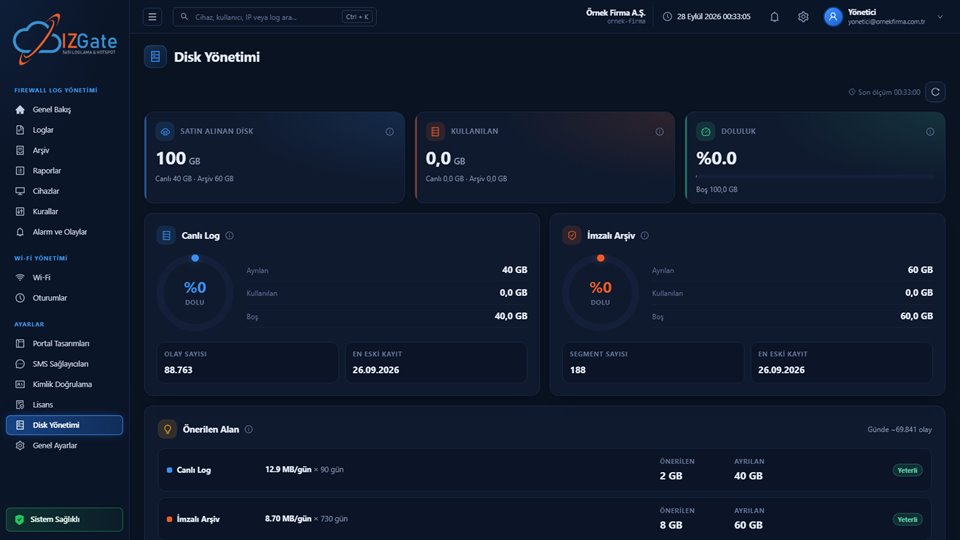
izgate Disk Management page: purchased disk, used, and fill-level cards with live/archive ring gauges
Disk Management: quota, usage, fill level, and the Recommended Space card
What's on screen?

Sections on the Disk Management page

  1. Top cards: "Purchased Disk" (total GB, live/archive share), "Used" (total plus the live/archive split), and "Fill Level" (percentage + free GB) cards, each with an info icon.
  2. Live Log card: a circular fill-level gauge, Allocated/Used/Free GB values, Event Count, and the Oldest Record date.
  3. Signed Archive card: the same layout with a circular gauge, Allocated/Used/Free GB, Segment Count, and the Oldest Record date.
  4. Recommended Space card: headed by the average daily event volume (e.g., "~69,841 events/day"); Live Log and Signed Archive rows show daily data rate × retention days, Recommended GB, Allocated GB, and a sufficiency badge ("Sufficient").
  5. Top right: the last measurement time and a refresh button.
What can you do?

Manage capacity by measuring, not guessing

Live and archive are tracked separately

Every log is written simultaneously to live storage (a fast-search database, kept for the period you set) and to the archive (a file system); total retention is the larger of the two. Disk Management presents these two areas with separate quota/usage/fill-level gauges.

Recommended Space

The required GB is calculated by multiplying your last 7 days' real event rate by your configured retention days and adding a 20% margin; if the allocated space is insufficient, the "Increase Space" button in the cloud takes you to your izgate.com account page.

Cloud disk sharing

On İzHost Cloud, you split your total quota between live and archive yourself (default suggestion 30%/70%); the live share must be at least 10 GB.

On-premises: real disk paths

In an on-premises deployment, the panel shows the fill level of the actual disk paths; separate disks for /log and /archive are required during installation (install.sh stops the install if there isn't a separate disk). Disk growth is not done from the panel; it is performed manually on the server.

Retention periods are independent

Live and archive retention periods are set in parallel and independently of each other in settings. Archive pruning cannot be undone, and only removes segments entirely outside the retention window, older than the cutoff date.

How does it work?

Assess capacity in three steps

1

Check the fill level

Check the total purchased disk, used space, and fill-level percentage from the cards at the top.

2

Read the Recommended Space

Compare the recommended GB — calculated from the last 7 days' event rate for live and archive — with the allocated space.

3

Grow it if needed

In the cloud, insufficient space is grown via "Increase Space" from your izgate.com account page; on-premises, it's grown by adding a new disk to the server.

Good to know

Limits, honestly

There is no disk growth from the panel. In an on-premises deployment, growing space is done manually on the server; in the cloud, your total quota is set by your İzHost Cloud plan, and an increase is requested from your izgate.com account page.
Separate disks for /log and /archive are required in an on-premises deployment; install.sh stops the installation if it doesn't find a separate disk.
No record is ever deleted because of fill level; archive pruning only clears segments that have fully exceeded the configured retention period, and this cannot be undone.
Frequently asked questions

About Disk Management

How is Recommended Space calculated?

Your last 7 days' real event rate is multiplied by your configured retention days, and a 20% margin is added; it's calculated separately for live and archive.

Is there data loss if the disk fills up?

No, no record is deleted because of fill level. Archive pruning only clears segments that have fully exceeded the configured retention period; this action cannot be undone.

Can I grow the disk from the panel?

No. In an on-premises deployment, disk growth is done manually on the server; in the cloud, the total quota is set by your plan and an increase is requested from your izgate.com account page.

Why are the live and archive disks separate?

The live log is designed for fast search, while the archive is designed for long-term, Law No. 5651–compliant retention; in an on-premises deployment, /log and /archive must be on separate disks.

Can I change the live/archive split in the cloud?

Yes, on İzHost Cloud you can split your total quota between live and archive yourself; the default suggestion is 30%/70%, and the live share must be at least 10 GB.

See all questions

Making your network Law No. 5651 compliant is a one-day job.

Configure izgate Cloud based on your number of firewall devices and storage needs; no setup, get started in minutes. Call us with any questions.